Hiển thị các bài đăng có nhãn Al Hartley. Hiển thị tất cả bài đăng

Number 1200: That crazy little mixed-up mag

Người đăng: Unknown on Chủ Nhật, 29 tháng 7, 2012

Crazy was an attempt from Atlas Comics to lure some of the readers who were buying Mad into parting with their dimes. Any Mad loyalist would immediately see the attempt fell short. But even if it sounds as if I'm dismissing it, I actually like this comic with its frenetic energy and lunacy popping out of every panel. I like the sexy pin-up art of  Al Hartley, who later went on to Archie and then to Spire Christian Comics; I like Bill Everett's funny Frankenstein, and Joe Maneely's artwork is, as always, superb. Ed Winiarski was a comic book journeyman, and Davy Berg later became a Mad-man. What Crazy didn't have was Mad creator/writer/editor Harvey Kurtzman, and it makes all the difference. There was Mad and then there was everyone else. It didn't make the imitators bad comic books, and Crazy is entertaining in its own crazy way, but in my opinion no Mad imitator ever reached the heights to which Kurtzman had taken Mad. (See more in my review of John Benson's The Sincerest Form of Parody, below the scans.)

Here's Crazy #1 (1953):


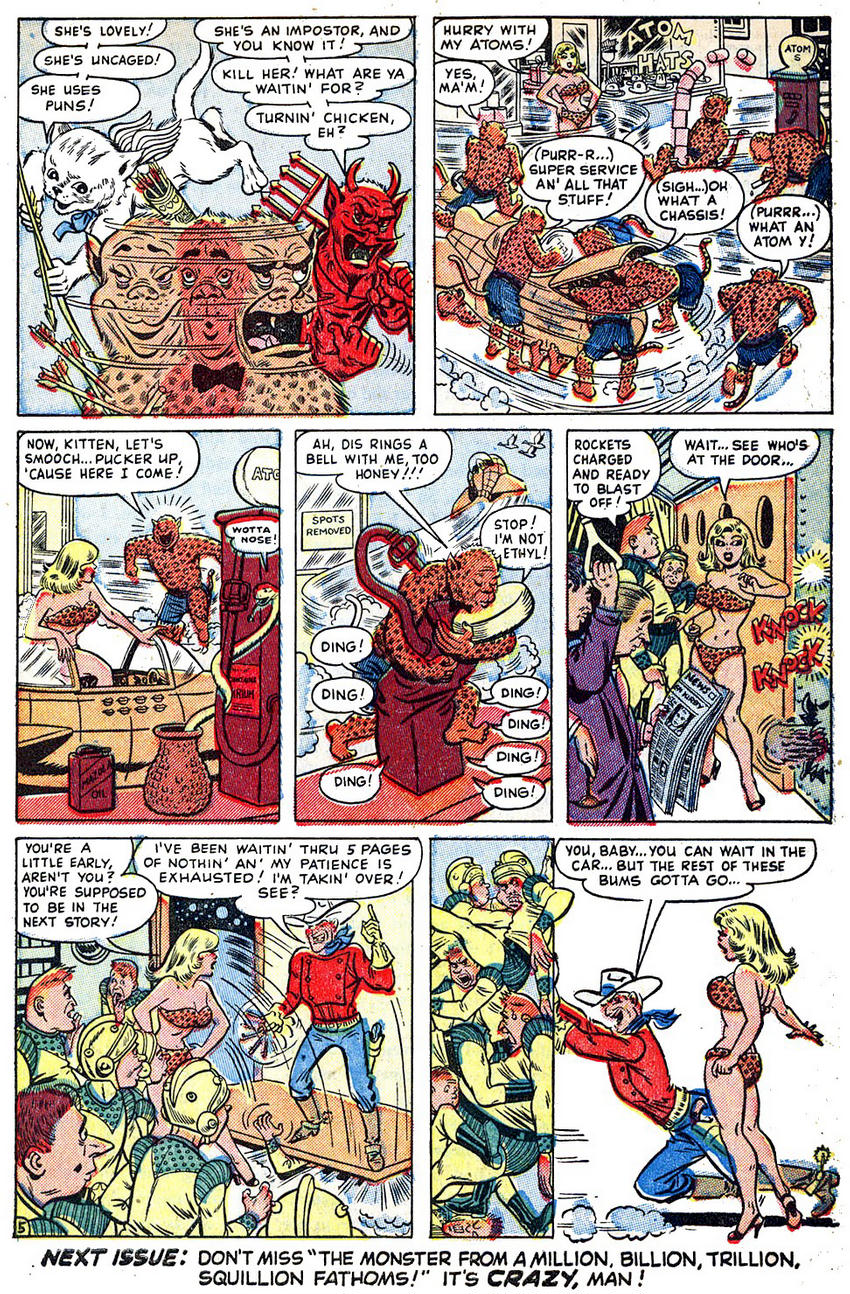


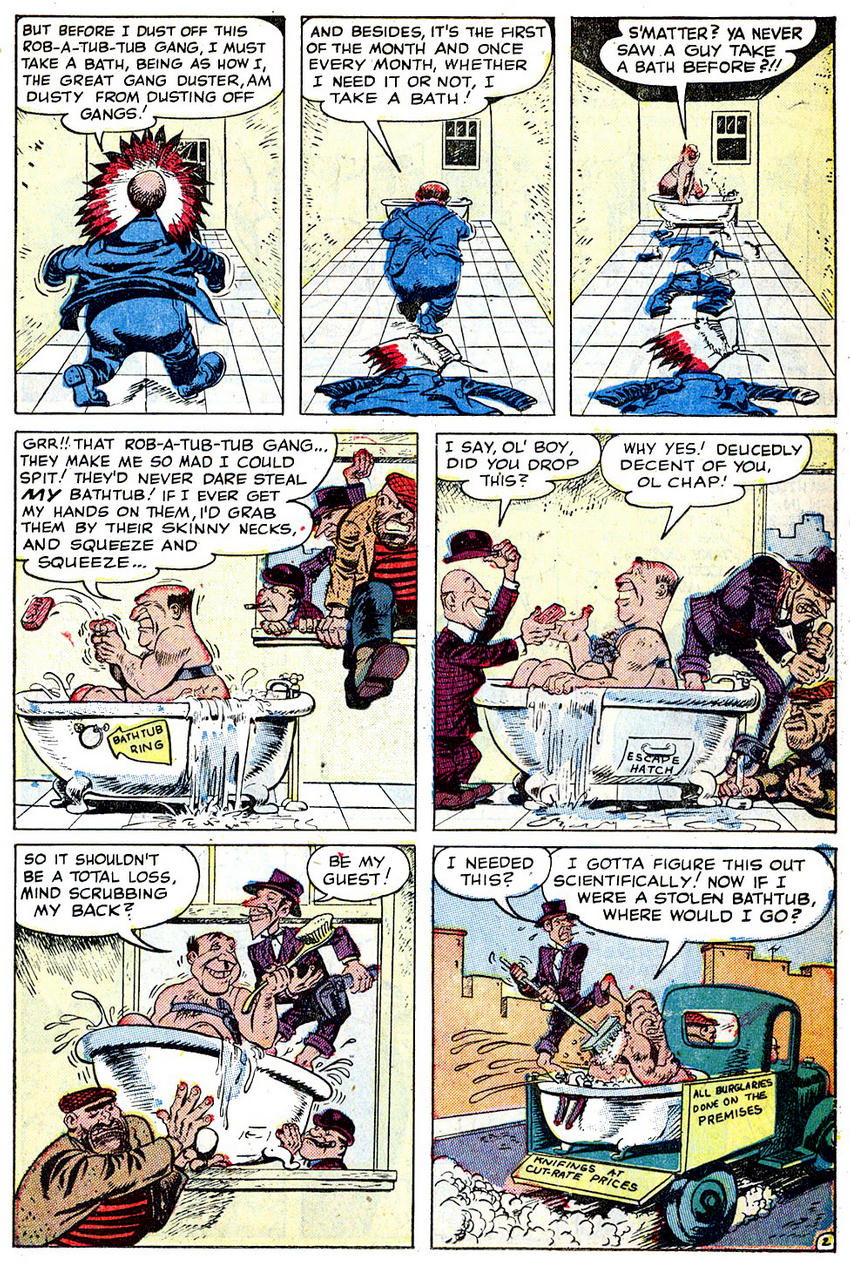


 ************
John Benson’s book, The Sincerest Form of Parody, is an excellent example of an overview (with examples) of a less-than-excellent subject. To wit (ho-ho), it is a book about all of them furshlugginer imitations of Mad comics that popped up in the wake of Mad’s success.

Benson, whom I admire as a comics historian,* obviously researched his subject matter. It appears that he read all of the Mad imitators of that period. The book reproduces a couple of dozen stories, some better than others, but none up to the high standards set by Harvey Kurtzman and Mad.


There just weren’t any other talents like Kurtzman out there at the time. There were writers who could write funny, and artists who could draw funny, but they couldn’t write and draw Kurtzman-funny. Even if the artists were technically good, they just didn’t come up to the level set by Kurtzman’s inspired cadre of cartoonists, artists like Elder, Wood, and Davis. At the time, they were the holy trinity of humor.

In my opinion, the best Mad imitations are what you see above you, the Mad-like comics from Atlas, and Harvey Comics’ short-lived Flip, with the sharp Davis-like drawing by Howard Nostrand.  EC Comics’ own in-house imitation, Panic, had some gems like Wood’s “African Scream,” shown in Pappy’s #871 or Elder’s “The Lady Or the Tiger,” the latter reproduced in Benson’s book. But same publisher or not, Panic was still a Mad imitator.

If Kurtzman worried at all about posterity, his name or his stories being remembered, he need not have been concerned. Kurtzman is one of the comic book geniuses, and they were rare, so we remember him. Reprints over the years have kept the twenty-three issues of Mad comics available to fans in various print formats, even two digital versions. The imitations just don’t get that kind of treatment, so The Sincerest Form of Parody makes some of the better imitators (“better” being subjective) available for the first time since their original publication almost sixty years ago.

I recommend The Sincerest Form of Parody with a qualification. The stories can be more bizarre than laugh-out-loud funny, and oftentimes (which happens with Mad, also) the satirical references are obscured by the half dozen decades between their first appearance and this book. Production is top notch, and the reproduction from the original four-color comic books is excellent.

It’s available from Amazon.com or your favorite bookseller. If your local comic shop has it or will order it for you, that’s even better.

The Sincerest Form of Parody by John Benson with introduction by Jay Lynch. Fantagraphics Book, 2011, trade paperback, 192 pages, 7 ¼” x 10”. $24.99 suggested retail.

*Benson also wrote Romance Without Tears, and Confessions, Romances, Secrets and Temptations, about the love comics of St. John publishing and writer Dana Dutch.
More about

Lorna, The Jungle Girl #11

Người đăng: Unknown on Thứ Sáu, 24 tháng 9, 2010


This comic arguably fits in better with the Golden Age, although its cover date is January 1955. "Women in the jungle" comics were extraordinarily popular during the 1940s and 1950s; it's not hard to guess that the appeal was the scantily-clad appearance of the females in question.

As the first story begins, Lorna spots the fierce Abaku tribe out to capture the peaceful Quaqui people and sacrifice them to their evil gods. As she rushes off to warn the Quaqui, she accidentally comes between a mother ape and her baby:

Mikki distracts the mother and Lorna and the monkey escape. As they head towards the Quaqui, Lorna muses that the mother was ready to die for her baby, just as she herself must be prepared to give her life for the Quaqui. She arrives as the battle begins and realizing that the peaceful villagers are no match for the Abaku warriors, she makes a bargain:

As she is about to be carried off to the sacrificial temple, she makes one request:

Things look bad for Lorna:

But Mikki unties her bonds and Greg, refusing to accept Lorna's argument that she made a bargain, comes up with an alternative sacrifice for the gods:

In the end, we learn that Greg, for all his admirable qualities, is just a little sexist:

Comments: Wow! Terrific characterization for Lorna, who really was quite prepared to sacrifice herself. Note as well her compassion for the mother ape. Granted, the Quaqui by analogy are the equivalent of her babies, but they are drawn by Werner Roth in a non-racist manner.

In the second story a "typhoon" (really a cyclone or tornado) is carrying off all the strongest men and animals in the jungle. Lorna discovers who is behind it here:

It carries her off to a hidden valley where she is attacked by a giant lizard and other things:

Eventually, she and Mikki end up atop a mesa with Greg, the strongest warriors and a few savage beasts. But then Chiga comes to see what happened to them, and Lorna commands him to transport them all back to the jungle. Later, Lorna tells Greg that Chiga agreed because he feels she's the strongest person in the jungle:

Comments: Silly story but I love the art by Roth again and the ending is amusing.

The third story is a backup featuring the "Jungle Adventures of Greg Knight". Greg is forced to kill a mother lioness when she attacks him in defense of her cubs. Now that the cubs are defenseless, Greg adopts them, knowing that the lioness' mate will come after him. That night, the lion attacks Greg's native assistant and carries him off. Greg follows and the cubs (who have gotten free of their cage) trail him. As the lion and Greg battle it out, he spots the cubs about to go over a cliff:

The lion, impressed by Greg's saving of his young, leaves him alone and carries off the cubs.

Comments: Entertaining story with art by Al Hartley, who would later become known for his Christian comics work.

The finale is Moon Madness. A pair of hoodlums try to take over Greg's animal refuge, but when the full moon comes up, all the animals go mad, and nearly kill the crooks. Lorna saves the criminals from certain death and eventually the moon goes behind a mountain, calming the jungle. What happened?

Comments: Note in particular that Lorna is not shy about expressing her affection for Greg. This completes the role reversal which has her as the most powerful creature in the jungle, and Greg as, well, kind of a wimp.

Overall I found the issue very entertaining, with terrific art and solid stories.
More about

Hansi, the Girl Who Loved The Swastika

Người đăng: Unknown on Thứ Sáu, 4 tháng 9, 2009


This one's a little outside my normal bailiwick, having been published in 1976, but it's such a wild issue that I couldn't resist sharing some parts with you. First, imagine being Jewish, walking past the local Christian bookstore, and seeing the cover of that comic through the window. You'd likely think that the local Christians were a bunch of skinheads.

The comic tells the story of Hansi, a young Czech girl who becomes enamored of the Nazis and the new opportunities for her to advance her education. She wins a scholarship:


As you can see, her mother (far right) is a little less thrilled about that prospect, and urges her to never forget Jesus. She arrives at her new school and learns about the Jewish Question:


Although Hansi never expresses anti-semitic thoughts in the book, she does become gung-ho about the Third Reich and discards her religion:


But as the war turns against the Germans and the Russians take Czechoslovakia, Hansi is imprisoned in a labor camp:


Deciding to break out, she tells her friend that they will go to West Germany, where the Americans are:


She makes it across the no-man's land into the American territory. At first she's suspicious of the young GIs:


But they win her trust and respect. In the postwar era she becomes a teacher in West Germany, and is eventually reunited with her childhood sweetheart. But something is missing in their lives, and eventually her husband finds it:


Well, you know Hansi, she never does anything half-hearted, and so her faith and her family increase over the years. Finally they emigrate to the USA:


Of course that's a bit of comic art license, as Hansi, a young woman during WWII, would be unlikely to have small children in the mid-1970s, when that kind of scene would be taking place. Hansi becomes a teacher in the United States, but she feels a calling to open up her home to young people who are in trouble and convert them to Jesus. She also takes her ministry to the local prison, where she gives a very inspiring speech:


Oddly, the speech is all about America, not about God, perhaps indicating that she's ready to put some faith in her country as well as in her religion. She does muse a bit earlier about how wrong she'd been to place faith in Nazism, so perhaps this is a turning point for her.

Comments: Hansi is certainly a very interesting and strong character, and Al Hartley draws her superbly. The story is based on the actual life of Maria Anne Hirshmann, originally with the same title, but apparently at some point changed to the less likely to mislead title of Hansi, the Girl Who Left the Swastika. Although obviously Christians would be most likely to enjoy this comic, it's quite entertaining just from a story-telling standpoint.

The cover still strikes me as crazy.
More about