Hiển thị các bài đăng có nhãn Strange Tales. Hiển thị tất cả bài đăng

Number 1607: Go-Go gorillas

Người đăng: Unknown on Thứ Hai, 21 tháng 7, 2014

As a kid I bought comics with gorillas on the covers. I still perk up when I see a story featuring those powerful creatures.

These two stories fit the bill. Both of them are tales about turning men into gorillas. Naturally, “the best laid plans...” you know...they often don’t go as we expect.

“Killer’s Arms!” is from Charlton’s Strange Suspense Stories #22 (1954), drawn by Leon Winik and Ray Osrin. “The Beast,” credited to Manny Stallman, is from Atlas’ Strange Tales #1 (1951).

Ook! Ook!


More about

Single Issue Review: Strange Tales #100

Người đăng: Unknown on Thứ Tư, 29 tháng 7, 2009


Marvel didn't spring out of thin air in the early 1960s; rather it developed slowly, evolving out of the Atlas line, which mostly consisted of so-called "horror" titles like Strange Tales, Journey into Mystery, Tales to Astonish and Tales of Suspense. This was the last all-horror Strange Tales issue; with #101 the magazine began featuring the Human Torch series.

The issue leads off with The Man in the Crazy Maze, drawn by Jack Kirby and inked by Dick Ayers. An unscrupulous carnival operator decides to make a maze where no route leads to the exit. By promising anybody who can reach the exit $10,000, he gets a lot of suckers to try to solve the maze. Indeed, it becomes a financial drain to the locals:


Then a new maze opens up in town. This one doesn't offer a prize, but it's fun and costs less than Charlie's maze. Losing business, Charlie accepts a deal from the new maze owner; if he can find his way out of the new maze, the new owner will pack up and leave town. Charlie agrees, but as he searches the new maze, he cannot find the way out. In the end we learn there is one exit: down to Hell, and the new owner is the devil himself.

Comments: Nice ending, overall an entertaining story. Charlie had killed a newspaper reporter who was onto him, so there's no question he deserved his fate.

The second story is The Imitation Man, again with Kirby/Ayers art. Zarago is a dictator of a Central American republic who looks to be patterned on Fidel Castro. As he rules with an iron fist, he's subject to occasional assassination attempts. He learns that an inventor has invented a machine that will duplicate any living creature exactly. Deciding that this will enable him to clone a double who can take risks by appearing in public, Zarago orders the inventor to copy him. Of course, you can guess the problem:


Realizing that his duplicate is just as power mad and greedy as himself, Zarago kills him. But in the meantime, the machine has spit out a dozen more dopplegangers, and the army, in the confusion, rises up against the multiple Zaragos and destroys them all, including the original. A democracy is instituted. And the inventor discloses to the reader that he planned this all along because Earth has no room for men like Zarago.

Comments: A clever story, although it would have been stronger if we knew who the inventor was. Was he a CIA agent sent to overthrow Zarago? Was he someone who lost a family member in the revolution that brought Zarago to power?

The third story is Beware the Uboongi. A US survey ship lands on Uranus, but fails to last the 24 hours required to establish it as our territory, as they are chased off by the fearsome Uboongi. The Soviets take advantage of the opportunity to send their own spaceship to Uranus, despite being warned that one of the two species of animals on that planet is deadly while the other is peaceful. The Soviets reason that the beast that looks like a rhino must be the dangerous one, while the sheep-like looking creatures are safe. But it turns out to be the wrong decision:


Comments: Entertaining, but entirely predictable. Art by Don Heck.

The final story is The Mighty Oak, drawn by Steve Ditko. An oak tree near the site of an atomic blast suddenly finds itself sentient, and capable of moving about.


The oak begins planting little acorns wherever it goes, knowing that they will grow up to be intelligent oaks as well, and one day, when they have sufficient numbers they will take over.

Meanwhile, what of the humans? It turns out that the people who ran the atomic exercise are not surprised to learn of the intelligent oak, and his plans:


Comments: Surprising ending. There were a lot of "mankind has screwed things up royally," plots around in the early 1960s; it seemed like a rare episode of the Twilight Zone that didn't have that as an underlying theme. Still it's hard to believe that not only would scientists welcome our new oak overlords, but that they'd actually create them.
More about

Dr Strange Versus Dormammu

Người đăng: Unknown on Chủ Nhật, 8 tháng 3, 2009

Up to this point, there was no particular reason to consider Dr Strange as one of Marvel's more interesting characters. Yeah, Ditko's art was psychedelic, but the series suffered from fairly mundane villains and supporting characters. There were hints that Dr Strange was becoming more popular; at first the character did not even appear in every issue. That quickly changed, and he even began to share cover space with the Human Torch.

But the series really took off with the battle between Dr Strange and Dormammu starting in Strange Tales #126. Here's the memorable splash page:


Dr Strange is summoned by the Ancient One. The Dread Dormammu is planning to leave the Dark Realm and come to Earth. The Ancient One is unable to face him, so the Doc is drafted as a replacement:


Now there's a villain worthy of facing Dr Strange. And a durable companion is introduced a short while later:


The actual confrontation between Doctor Strange and the Dreaded One takes place in the following issue. We learn that Dormammu is the only thing keeping the Mindless Ones from breaking through into the Dark Realm.

In the battle itself, we see signs of Ditko's influence on the character:


And when the Mindless Ones break through, we see that Dr Strange is a man of honor:


He lends his support to Dormammu and together they repel the invaders, putting the Dreaded One in Dr Strange's debt:


This highlights one of the odder aspects of some of the Marvel villains. There were several who possessed a moral code despite their essentially evil nature--Dr Doom, the Sub-Mariner (back when he was played as a villain) and Galactus were notable for this supposed trait. In a sense this is just another out for the writer, which may explain why Lex Luthor underwent a similar transformation in the 1960s.
More about

Single Issue Review: Strange Tales #120

Người đăng: Unknown on Thứ Tư, 31 tháng 12, 2008


Strange Tales was another one of Marvel's anthology magazines. It had originally been a horror comic, but after the debut of the Fantastic Four, the cover slot and main feature had been turned over to the Human Torch effective with Strange Tales #101.

Crossovers were frequent in the Marvel Silver Age, and the Human Torch's feature was no exception. It was perhaps inevitable that the Torch and the Iceman, both teens and representing the opposite ends of the temperature spectrum, would end up meeting. As it happens, Johnny Storm is on a date with his gal Doris on a pleasure boat around Manhattan, while Bobby takes the same ride solo. He tries to pick up Doris, but she's not interested:


As it turns out, and as shown on the cover, the ship is attacked by Captain Barracuda, and the Iceman and the Torch go into action:


Comments: An amusing little story with solid sequential art by Kirby, although I confess that Dick Ayers' inks leave me cold.

The backup feature is Dr. Strange, who had debuted only ten issues earlier in this magazine. This series had still not hit its stride and this story is a silly little adventure about a haunted house that a reporter has agreed to stay inside overnight. Predictably, he emerges much the worse for his experience:


Comments: As indicated, this is a pedestrian tale, lent some luster by Steve Ditko's dark, brooding artwork:


This series was about to lift off into the stratosphere, but there is little sign of it here.
More about

Strange Tales Annual #2

Người đăng: Unknown on Thứ Hai, 12 tháng 3, 2007

Here's an oddball early teamup of Spidey and the Human Torch. Marvel quite naturally wanted to establish some bond between their two teenage superheroes (at the time, this being before the debut of the X-Men).

The Torch had been a major character in the Golden Age for Marvel (then known as Timely) and he was also 1/4 of the Fantastic Four. Spidey was a new character, whose comic was then less than a year old. Strange Tales was the magazine that featured the Torch in his solo adventures. So one would think that Johnny Storm would at least hold his own in the teamup story. But it did not develop that way.

In typical Marvel fashion the story starts out with a fight between the two heroes because of a misunderstanding. But where DC would have ended it in a draw, Marvel decided to have one character win the fight:


And when they clash again, Spidey is prepared:


Of course, eventually he convinces the Torch that he is not responsible for the theft and they team up to fight the real criminal, the Fox. Although the Torch does save Spiderman in one memorable moment, for the most part it's Spidey following the clues, Spidey asking the questions, and the Torch mostly looking like an ornament. When it comes time to catch the villain, guess who does it?


And Peter handles this with his usual lack of class while in uniform:


The Human Torch co-starred with Spiderman in several adventures including a memorable run in ASM 17-19. But you could see the passing of the baton to the new guy in this story, in what obviously turned out to be a preview of things to come. The Torch ended up not a strong enough character to cover his own mag in the Silver Age, and eventually was squeezed out of Strange Tales in favor of Nick Fury Agent of Shield. And Spidey... well I guess you know that story.
More about

Secret Agent Man

Người đăng: Unknown on Thứ Sáu, 20 tháng 1, 2006

Comic publishers have always dutifully scanned popular culture for clues as to topics that appear to interest teenagers. In the 1950s, comics were produced to capitalize on the appeal of Westerns at the movie theatre. When monster movies were popular, monster comics were not behind. And when spies and secret agents became hip in the mid-1960s, the publishers rushed to fill the demand.

Marvel made a particulary strong entry into the secret agent genre with the paranoia-tinged Nick Fury, Agent of Shield series. NFAS took over the lead feature in Strange Tales that had previously belonged to the Human Torch (and briefly, Torch and the Thing team-ups) effective with issue #135, featuring a terrific cover by Jack Kirby:


(Note: Fred Hembeck has a cool takeoff on this cover and some memories of the NFAS Saga in the January 17, 2006 edition of his blog.)

Fury had been a character in the Marvel universe for several years already, albeit as a historical character. He was Sgt. Fury, leader of the Howling Commandos, a World War II fighting squadron. Now Marvel decided to age him a few years (but not quite the 20 that the calendar called for) and make him a secret agent.

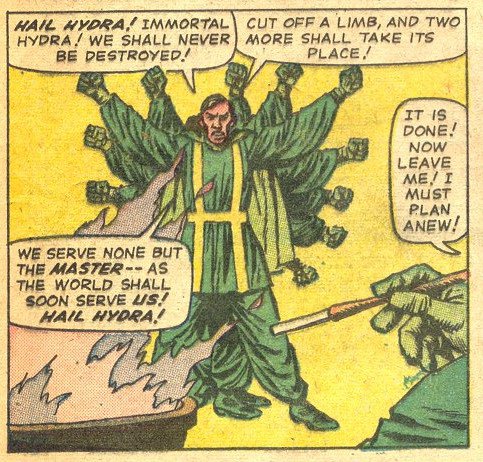
S.H.I.E.L.D. of course was a direct swipe of U.N.C.L.E. (which was probably a swipe itself of S.P.E.C.T.R.E.) and stood for Supreme Headquarters International Espionage Law-Enforcement Division. Shield's chief enemy was a group called Hydra, which mercifully does not stand for anything, but does have some cool rituals:


NFAS was blessed with great stories and artwork. After handling the introductory story in Strange Tales #135, Jack Kirby did layouts for the amazing Johnny Severin for the next few issues, followed by a year or so of rotating artists including Ogden Whitney (!). Finally in Strange Tales #151, a new artist was hired for the feature who would define Agent of Shield for the next few years: Jim Steranko. Steranko's style was unlike most comics artists of the time; he was heavily influenced by the psychedelic posters and album art of the late 1960s as this cover shows:


In early 1968, Marvel decided to quit doing anthology magazines. Strange Tales was changed to Dr Strange with issue #169, and Nick Fury Agent of Shield was given its own title starting with #1. Unfortunately the title struggled a bit on its own apparently, possibly because of the inevitable decline of the secret agent genre after the initial fad died down. The first twelve issues of NFAS were published on a monthly basis, but with #13, the frequency was changed to bi-monthly and the title only lasted to #15. A year later Marvel published three more issues but they were reprints of the early Strange Tales stories.
More about