Batman II & Robin II.

Người đăng: Unknown on Chủ Nhật, 12 tháng 11, 2006

Although Batman did not have imaginary stories per se in his comics, there were many stories that served the same function--dream stories, most notably. Along the same lines were the Batman II and Robin II stories. They were stories that Alfred, Batman's butler, wrote about a possible future time when his employer had retired from crime-fighting and been succeed by Dick Grayson as Batman, while the new Robin was none other than Bruce Wayne, Jr., the offspring of Batman and Kathy Kane, the former Batwoman.

The series debuted in Batman #131, the April, 1960 issue. Batman has just retired in favor of Dick Grayson, and Bruce, Jr., wants the job of Robin. Over time, he proves his mettle, although typically for a youngster he is impulsive and prone to not thinking things through. However, in a noticeably weak ending the new Batman and Robin are about to be killed when Batman I and Batwoman show up to save them.

The duo return in Batman #135. This time they are faced with a criminal bent on revenge against the original Batman. They are captured, but fortunately the original Batman saves them.

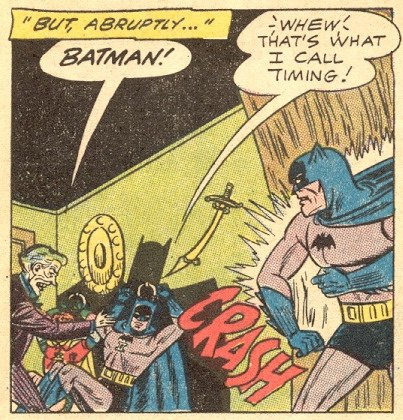
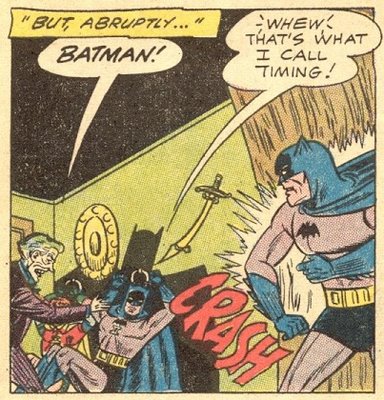
Are we beginning to see a problem here? These are supposed to be tales of the new Batman & Robin team, and yet every time, just as they are about to be killed, the old Batman shows up and saves them. Ditto with Batman #145's third entry in the series, The Son of the Joker:

More about

The Brave & The Bold

Người đăng: Unknown on Thứ Bảy, 11 tháng 11, 2006

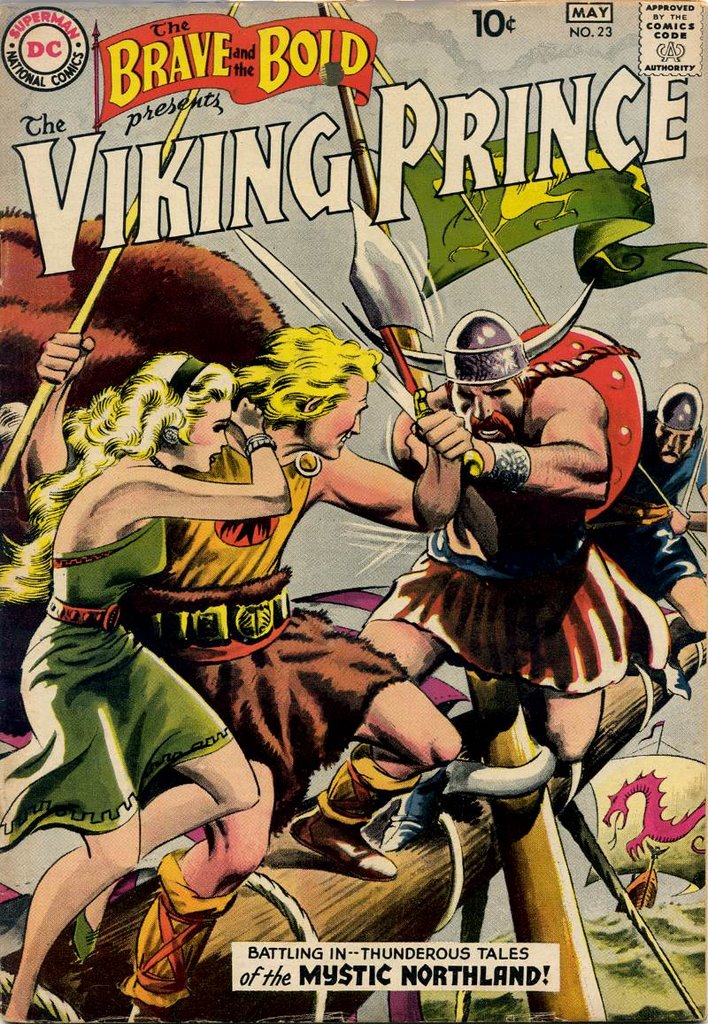
One of the more interesting DC magazines of the Silver Age was the Brave & the Bold. The first issue hit the stands in Aug-Sept 1955. Perhaps inspired by the movie The Black Shield of Falworth, it featured the adventures of warriors from the past: The Golden Gladiator, the Viking Prince, and The Silent Knight. The features, drawn by Russ Heath, Joe Kubert and Irv Novick were terrific reads with some famed covers:
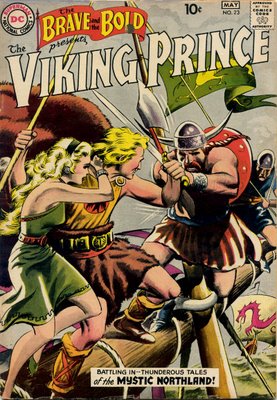


But after issue #24, DC decided to take the magazine in a new direction. Showcase, another DC magazine, had been churning out new characters (or revamps of old ones) on a regular basis. With issue #25, Brave & Bold became another tryout magazine for new features that DC hoped would catch on with the public.

The first effort was called the Suicide Squad, a Mission Impossible-type force that did not seem to catch on with young boys. After three issues, Brave and Bold came up with a winner as the 28th issue featured the Justice League of America. The JLA was an organization of superheroes, including (at first) Aquaman, Flash, the Martian Manhunter, Wonder Woman and Green Lantern. Batman and Superman were also members, but at first they were usually kept in the background, probably for fear they would dominate the group.

This series succeeded quite memorably, but oddly that turned out to be the exception rather than the rule. After three JLA tryouts, Brave & Bold tempted youngsters with Cave Carson's Adventures Inside Earth. No sale. Then came three issues of Hawkman drawn by one of his GA artists, Joe Kubert. These also failed to fly off the shelf, so DC came back with three more tryouts for the Suicide Squad. When the kids failed to drink the Kool-Aid, the Brave & the Bold went back for two more issues of Cave Carson, followed by three more of Hawkman.

None of those features graduated to headliner status. Particularly troubling to DC must have been the Hawkman failure; this was the first superhero mag put out by DC in the Silver Age which failed to catch on (although it did later after a third trial run in Mystery in Space).

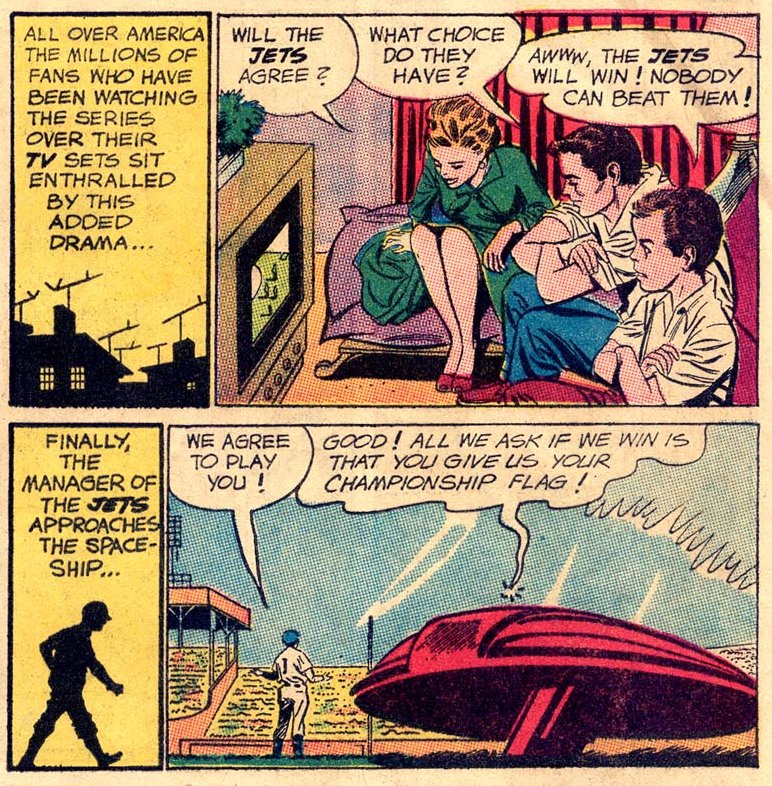
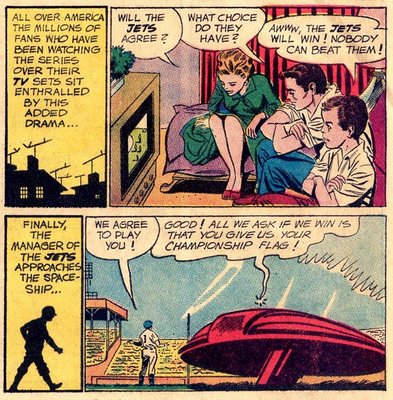
Brave & Bold did try something different with #46-49: Strange Sports Stories. These were oddball adventures mixing science fiction with sports. Drawn by Carmine Infantino, they also included something unique; the narrative captions were given illustrations too:


But once again, the sales did not justify creating a new title, so with #50 they again tried something different: A teamup of two of DC's existing superheroes, in this case the Martian Manhunter and Green Arrow. B&B #51 featured Aquaman and Hawkman. Then, in a surprise manuever, DC teamed up several of its top war comics features: Sgt. Rock, Johnny Cloud, and Jeb Stuart for #52; this was the first crossover for the war heroes, although there would be more. Issue #53 featured a teamup of the Atom and the Flash.

Finally, DC hit the jackpot again in B&B #54, with the Teen Titans (although they were not referred to as that in the story or cover). Kid Flash, Aqualad and Robin teamed up to help some of their fellow teenagers. There followed two more teamup issues before Metamorpho debuted in B&B #57 and #58. Batman hooked up with Green Lantern in #59, followed by another Teen Titans tryout.

In Brave & Bold #61 and #62, DC tried bringing back some more Golden Age heroes, with Starman and the Black Canary. Although the series did not take, the stories in those issues are particularly gorgeously drawn by Murphy Anderson and are well-worth reading.

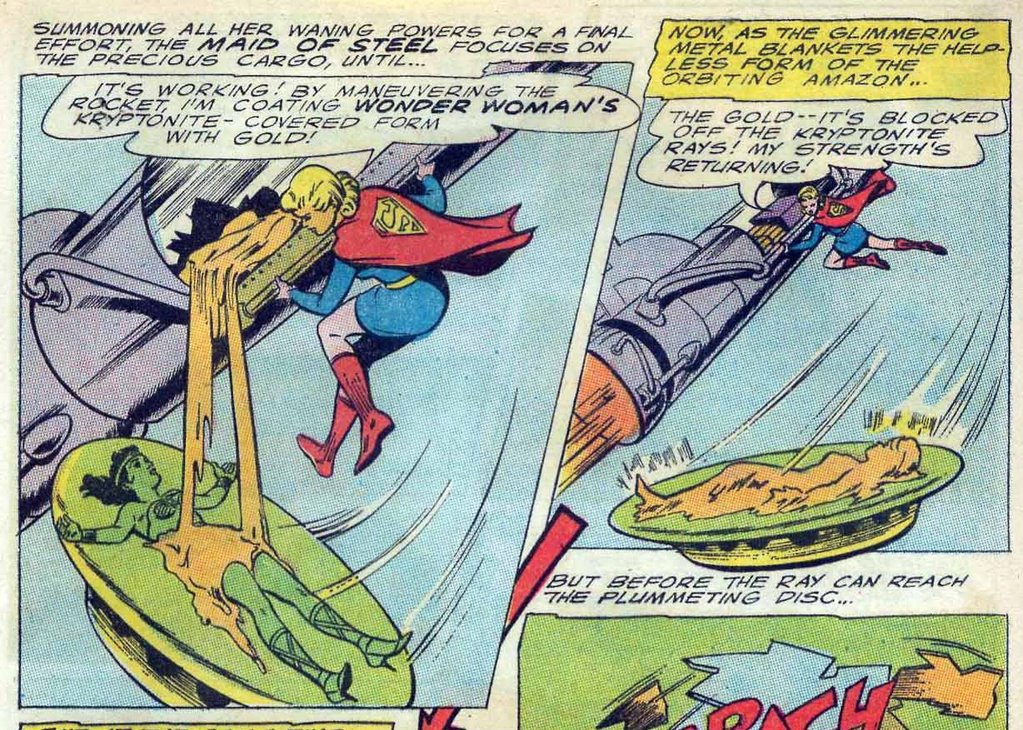
B&B #63 features a meeting of Wonder Woman and Supergirl. The story concerns Supergirl's desire to be more like a normal girl. She decides to abandon fighting crooks in favor of being a fashion model in Paris, where she falls for a young Frenchman. Wonder Woman, dispatched by Superman to talk her out of it, finds herself enticed by the simple life. The story does reveal one major drawback of teamup stories. Because they are created by people other than their usual writers and editors, there are frequent goofs. For example, consider this embarrassing flub:
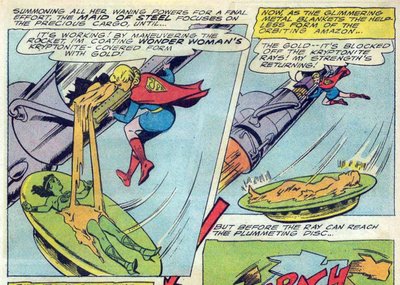


Of course, it was well-established in the Superman books that only lead could block Kryptonite radiation.

The next three issues featured more of the seemingly random teamups--Batman/Eclipso, Flash/Doom Patrol and Metamopho/Metal Men. By this point (mid-1966) it was obvious that the Batman show was a major hit, and for the next six issues (a full year), the teamups featured Batman and another DC character. Batman did not appear in B&B #72, which featured the Spectre and the Flash, or #73, with Aquaman and the Atom.

After that, though, the teamups always featured Batman, I believe all the way to #200, the final issue for this interesting title.
More about

Journey Into Mystery #87-90

Người đăng: Unknown on Thứ Năm, 9 tháng 11, 2006

As remarked by Thelonius Nick in the comments on the earlier Thor post, Stan Lee seemed unsure as to what to do with the Mighty Thor at first. The Thunder God was far too powerful and cosmic a character to waste against the usual crooks & mobsters. In Journey into Mystery #87 he defeats a plot by the communists to kidnap American scientists.

Loki returns in #88. Having learned of Thor's secret identity, he forces the Thunder God to choose between recovering the hammer and saving Jane Foster. Then Loki surrounds the hammer with a force field, preventing the now helpless Don Blake from recovering his powers. Fortunately Don tricks Loki into removing the force field and sends Loki back to Asgard.

In #89 Don and Jane are kidnapped by mobsters to operate on a wounded crime boss. In a classic example of Deus Ex Machina, he prays to Odin to intervene when he and Jane are about to be killed despite saving the mobster's life. Odin sends down a thunderbolt to save them. We also get a new power for Thor (that is never again mentioned); that of super-ventriloquism.

In #90, Thor again fights aliens. Ho-hum.

Lee still had not found the right format for the Mighty Thor in these issues. Nobody really seems able to handle the Thunder God, and so the plot often revolves around him somehow losing control of his hammer, despite its well-established tendency to return to him.

This is similar to the problems that DC had with Superman in the 1940s. DC had solved it by using deceptive villains like Mxyzptlk, the Prankster and Wolfingham; even Luthor was usually operating behind the scenes. But of course, this had the tendency to diminish the value of the powers that Superman possessed, which, after all, was what made the character different.
More about

Goldilocks

Người đăng: Unknown on Thứ Tư, 8 tháng 11, 2006

I've talked briefly about Thor in the past, but now it's time to discuss him in a little greater detail. Thor is the Norse god of thunder. His initial appearance in Marvel was in Journey Into Mystery #83. JIM was one of Marvel's horrible "horror" mags, which featured stories like "I Unleashed SHAGG Upon the World!" and "I Found RRO... The Thing from the Bottomless Pit!"

Don Blake, a lame physician, was on vacation in Norway when he discovers a plot by alien invaders from Saturn. He is spotted by the Stone Men, and runs into a cave. There he discovers a small staff, which is fortunate because he has lost his cane. But when he strikes the cane against a boulder blocking his way, he transforms suddenly into the Mighty Thor!


Thor has many powers. He is virtually invulnerable and fantastically strong. But even more important is his mighty hammer (the staff transformed), which makes it possible for him to fly and which destroys almost anything it's thrown against and returns automatically to his hand like a boomerang. It can also cause lighting and storms.

But of course with this power comes a weakness. If the hammer leaves Thor's hand for 60 seconds, he reverts to Don Blake, the lame physician. As always in the Marvel universe, there is also a love interest. Nurse Jane Foster secretly loves Dr Blake, and he adores her but worries that she could never love a weakling like him.

Initially Thor battles fairly traditional enemies for superheroes: Aliens intent on a hostile takeover, communist dictators and assorted crooks. But quickly a supervillain worthy of Thor's interest was discovered; his evil brother, Loki, the God of Mischief. Loki first appeared in JIM #85, and was returned quite often in the early issues: He is featured in JIM #88, 91, 92 and 94 as well as Avengers #1.

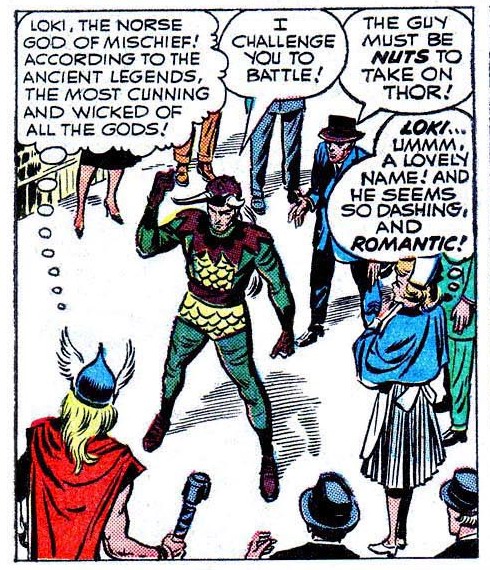
The characterization of Nurse Jane Foster in these early issues stinks. She's the typical 1960s Marvel eye-candy airhead. We see her thinking about how much she loves Don Blake, but she has an eye for Thor (not realizing that they are actually one and the same). And the first time Loki shows up, he's quite a prize as well:


This is all too typical of Marvel at the time. Girlfriends/love interests existed mostly as potential hostages for villains and were generally placed in traditional women's occupations: nurses like Jane Foster and secretaries like Karen Page, Betty Brant. Compare that with DC, which had Lois Lane as a reporter, Vicki Vale as a news photographer, Jean Loring a young attorney and Carol Ferris running an aircraft factory.
More about

Robby Reed Unveiled!

Người đăng: Unknown on Thứ Ba, 7 tháng 11, 2006

In the final (for now) post on Dial B for Blog. His blog is incredible; undeniably the finest comics blog on the net.
More about

More DC Scientofascism

Người đăng: Unknown on Chủ Nhật, 5 tháng 11, 2006

As we have discussed in the past, if there was a religion in the DC Universe back in the Silver Age, it was science. In a way, this is probably a natural outgrowth of the postwar era, as it seemed that technology, government and industry were forging ahead to move us into the glorious future. But it looks just a tad creepy with the benefit of hindsight.

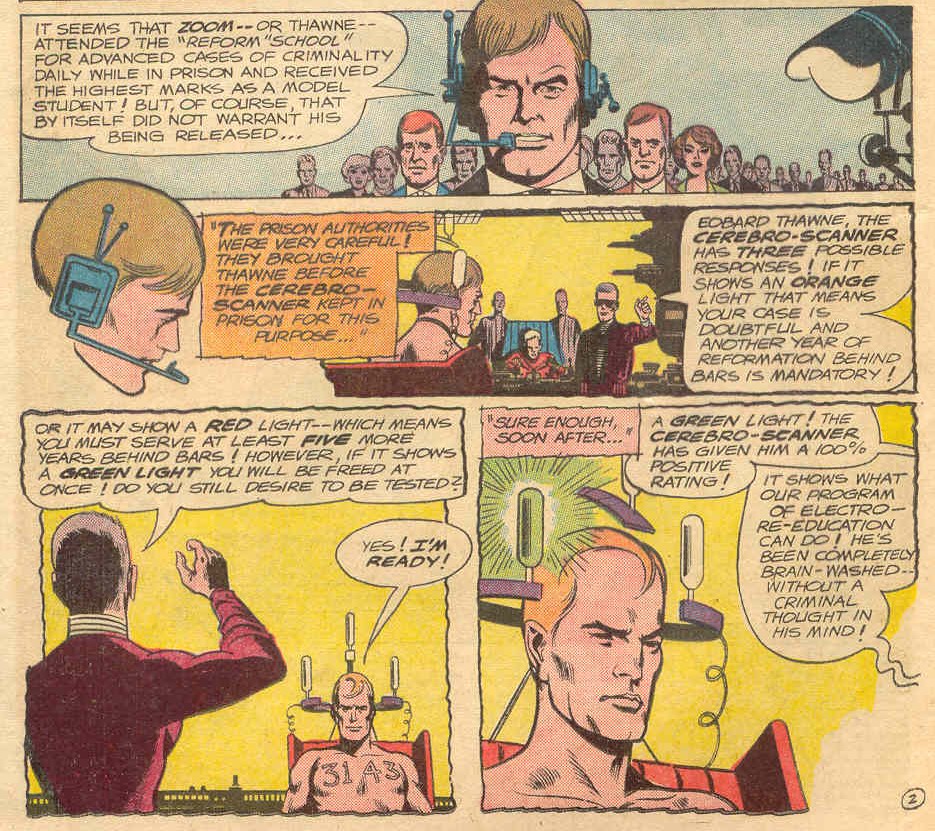
For example, consider this bit from Flash #153, the June 1965 issue. Professor Zoom, aka the Reverse Flash, aka Eobard Thawne has apparently reformed thanks to the "electro-reeducation" provided by prison authorities in the year 2465:


Of course as often happens in these stories, there is something wrong with the machine. In fact, Professor Zoom has tampered with the Cerebro-Scanner to make sure that he will pass the test despite not having gone straight at all. As was the case in Superman #132, once the machine is repaired, nobody stops to think, hey, maybe we shouldn't be setting murderous crooks free just on the basis of them passing a test.
More about

Challengers Part II

Người đăng: Unknown on Thứ Tư, 1 tháng 11, 2006

I didn't have the time or the inclination to read all of the Challengers series at this point, so I thought it might be entertaining to jump ahead five years and check the changes.

Challengers of the Unknown #31 contains a retelling of the Challengers' origin with new details. We learn that before the fateful flight, Rocky had defended his wrestling championship despite an attempt by the mob to influence the bout.

More unbelievably, Prof Haley was reintroduced as a rich delinquent. Uh, how did he get the nickname "Prof" then? He reforms after helping rescue an ancient statue from the deeps via his skin-diving ability.

Red Ryan, who had originally been introduced as a circus daredevil (only to have Kirby ignore that aspect of him), was now reincarnated as a mountain climber, and electronics expert. He builds a radio tower on a mountain with the money of a rich patron to educate the poor people of a valley in South America. However, it turns out that the patron really intended to use the tower to transmit propaganda and become a local dictator, fortunately prevented by Red.

Ace Morgan was a pilot who had contracted to carry high explosives for miners in his plane, but was forced to toss them out when they broke loose. He manages to hit the mountain in a place that reveals a vein of ore, so the miners are happy.

However, as the four men fly in Ace's plane, they feel like failures for one reason or another, especially when the plane conks out and they must crash land in a forest. Given a second chance, they feel like they are living on borrowed time, and resolve to do something more with this second chance at life.

This origin retelling is contained within a larger story where a mysterious stranger claims to have rescued the Challengers from their plane. Thus they were not really saved by "fate" as they had long believed. Their rescuer, a Mr Clayton, presents evidence. He is in a jam and needs the Challengers to help him reassemble an ancient statue. It turns out the statue's actually a giant robot that has two arms missing which when assembled will give him incredible power. But the Challengers eventually realize Mr Clayton did not really save them and defeat his robot.

Comments: Interesting but uneven origin retelling by DC.

Challengers of the Unknown #32 contains two stories. The first one features Volcano Man, who had previously appeared in Challengers #27. In the second story we learn that the Challs had picked up an alien pet whom they called Cosmo. He seems to have almost unlimited mental powers, so much so that he dwarfs the rest of the team. Looking back I see that Cosmo first appeared in Challengers #18, and had made a couple intermediate appearances. In this story, they discover his original alien owner, who is happy to let them keep the pet since it is proving of so much use. Perhaps typically for DC, this ended up being the last time Cosmo appeared in the Silver Age Challengers; probably for the reason noted above; he was just too powerful and made it too easy for them to get out of tight scrapes.

My previous article on the Challengers is here.
More about