Rock Against Racism

Người đăng: Unknown on Thứ Hai, 18 tháng 1, 2010


Sometimes I underestimate DC in the 1960s. Awhile ago I noted the absence of black characters in DC comics during the Silver Age, but as you can see, there's one on the cover of this mag, from November 1965. And he's even more prominently featured on the splash page:

The story starts off in a clearing somewhere in Western Europe. Rock, Wild Man and a new recruit named Jackie Johnson (the black guy) have been captured by a Nazi squadron, and the biggest German is having a bare-knuckled brawl against JJ, who refuses to fight back. Why? Rock knows:

In a flashback we learn of the first time Rock had seen Jackie Johnson:

Johnson indeed proved to be a comer, eventually winning the heavyweight championship. But he lost a crucial match against this same German:

This is a thinly-veiled retelling of the Joe Louis-Max Schmeling rivalry; more on this at the end of the post.

In the story, Johnson didn't get his revenge match against the Storm Trooper, who went into the German Army, so this was their first meeting since the heavyweight fight. Later, Johnson joined Rock's unit in the Army, but was still haunted by his defeat in the ring:

But it looked like there would be no chance for a return match; after all the German fighter could be anywhere from France to Russia. But as it turned out they did meet, under less than optimal conditions, as the Americans were captured by the Storm Trooper's unit. And:

Bringing us up to where the story began. The Nazis make it clear that they will kill everyone if Jackie defeats the Storm Trooper, so the black man holds back. But:

The Nazis cannot tolerate this, so they shoot at both fighters, critically wounding the German, although Jackie manages to avoid the bullets. Rock and Wild Man attack their captors and reverse the situation. But the Storm Trooper needs a transfusion if he is to survive, and perhaps inevitably:

And in the end, the German realizes he was wrong:

Comments: Wow! What a terrific story! Kudos to Robert Kanigher and Joe Kubert for providing what must be considered one of the Silver Age's finest tales.

Joe Louis and Max Schmeling. In 1936, Joe Louis looked unstoppable at 23-0. Max Schmeling was a former heavyweight champion, but he had won his title via a disqualification of when Jack Sharkey hit him with a low blow. So Schmeling was considered just a tune-up before Louis boxed for the championship. But Schmeling had trained hard for the fight and noticed a flaw in Louis' style which he was able to exploit in knocking out the Brown Bomber at Yankee Stadium in the 12th round.

Here's how kids were taught the story at the time, from a text story in Superman #118:

The reality is much more complex, as the Wikipedia entry on the rematch notes:

Schmeling did not relish being the focus of such propaganda. He was not a member of the Nazi Party and – although admittedly proud of his German nationality – denied the Nazi claims of racial superiority: "I am a fighter, not a politician. I am no superman in any way." Schmeling had a Jewish manager, Joe Jacobs, with whom he refused to part despite significant pressure, and, in a dangerous political gamble, refused the "Dagger of Honor" award offered by Adolf Hitler. In fact, Schmeling had been urged by his friend and legenday ex-champion Jack Dempsey to defect and declare American citizenship.

Nevertheless, the Nazi regime exploited Schmeling in its propaganda efforts, and took careful steps to at least ensure Schmeling's nominal compliance. Schmeling's wife and mother were kept from traveling with him to avoid the chances of defection. Schmeling's entourage also included an official Nazi Party publicist. The publicist not only controlled any possible contrarian remarks by Schmeling, but also issued statements that a black man could not defeat Schmeling, and that Schmeling's purse from the fight would be used to build more German tanks.


Both Louis and Schmeling did serve in their respective military forces in World War II, although of course they did not meet during those years, on the battlefield or elsewhere. After the war, they became close friends, with Schmeling serving as a pallbearer at Louis' funeral in 1981.

Update: Here's a video of the second bout:
More about →

The Story of Garth the Strong; The Captive; Garth In Space; The Doomsmen & The Gold of Ragnarock

Người đăng: Unknown

 Hello friends,

Sharing these strips at request of one of most active visitor OLD MAN MOZZ as sooner I could. Hoping you all will enjoy!

I found this information & these strips shared by Pete. All credits go to him.


He writes:

Garth is a UK comic strip which ran in the Daily Mirror from 1943 until 1997.

The strip is in the science fiction-adventure genre, Garth has traveled through time and space, met numerous famous people from history and even has a romance with Astra, the goddess of love.

The strip was created by Steve Dowling, an artist and writer for the Mirror, who worked on many of the strips created for the Mirror in the forties.

The art was by Dowling and John Allard until Dowling retired, after which Allard continued the art solo.

When Allard retired in 1971 the strip was continued by Frank Bellamy.

Prior to his work on Garth, Bellamy is most famous for his work in the UK weekly TV Century 21 where he drew the colour centrespread Thunderbirds strip, based on the Gerry Anderson tv show, from 1966 to 1969.

Bellamy worked on Garth until his untimely death in 1976 when Martin Asbury, another acclaimed UK artist, took over drawing the strip until it's conclusion in 1997.

Asbury also wrote the last seven stories.

On the writing side, the most notable writer of Garth is Peter O'Donnell who worked on Garth from 1953 to 1966. O'Donnell wrote some of the best stories in the series, including The Troll and The Rebels, an alternate Earth story where Garth is up against Adolf Hitler.

Recently the strip has made an online return on the Mirror's website.

This first upload contains several complete stories which have been scanned from the booklets available. They cover all the eras including the first digital story.

Garth In Space is from the Daily Mirror Annual 1970, drawn by the regular artists at the time, Steve Dowling and John Allard, and was scanned and edited by me.

The Gold of Ragnarock is the first story from the new online series. I edited the web pages but there were problems with the file, hence the fixed in the title. Thanks to Slinky who also did a second version.

The Doomsmen and The Beast of Ultor feature the work of Frank Bellamy.

The Captive is from 1957 and is written by Peter O'Donnell, with art by Dowling and Allard.

The Man-Hunt is the last story Frank Bellamy drew, and was finished by Martin Asbury.

Sapphire is by Martin Asbury.

The Story of Garth the Strong is a preview of the first Garth story.

In the paper it was just titled 'Garth', I have used the opening text from promotional material issued by the Mirror for a new title.

I am working on the first story using the scans from the Mirror's records. The upload of that should hopefully be later in the year,and will be followed by all the stories in chronological order.

Just like Garth himself this selection travels through time. If you like time travel, space adventure and great story and art, I hope you find something here to enjoy.
Hopeful you enjoy the stories as much as I did when I read them in my youth.


3 more strips shared by him are available HERE. I'll try to share rest as he'll put online.


  PREVIEW Garth 001 - The Story of Garth the Strong


 Garth - The Captive


 Garth - The Doomsmen


Garth - The Gold of Ragnarock(Fixed)
More about →

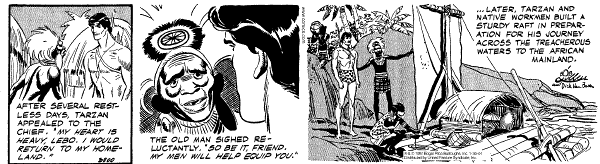
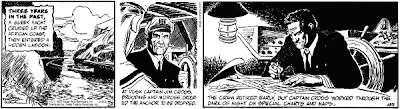
Tarzan Daily Strips by Robert Lubbers & John Celardo (to be continued)

Người đăng: Unknown on Thứ Sáu, 15 tháng 1, 2010

Hello Tarzan fans!

As promised,  posting not only better and extended version of the daily strips by Robert  Lubbers  (1950-1954), but many more by John Celardo (1953-1968).

Thanks to Emile who downloaded every strip manually, now we can read this version.

The information available at www.erbzine.com & other sources regarding number of the panels had confused me. Thanks to  Col. Worobu this problem was solved.


00 -  Tarzan King of Duru - 3462 to 3511 (Incomplete)


01 - The Swamp People - 3512 to 357


02 - The Coffee Planter - 3574 to 3633


03 - The Cannibal Village - 3634 to 3689


04 - Gunnar Milo - 3690 to 3757


05 - The Hunter (8-27-51 to 10-15-51) - 3758 to 3800


06 - The Pirates 10-16-51 to 12-22-51 -3801 to 3858


07 - The Loggers 3-17-52 to 5-15-52 - 3931 to 3982


08 - Opar - File name: 3983 to 4056


09 - The Inheritance 8-11-52 to 10-13-52. - 3983 to 4111


10 - The Skull Clan 10-14-52 to 1-16-53 - 4112 to 4174


11 - The Rogue Elephant 1-17-53 to 3-23-53


12 - The Foreign Legion 3-25-53 to 5-21-53


13 - The Foaming Death 5-22-53 to 8-11-53


14 - The Terror of Kraka 8-12-53 to 10-22-53


15 - The Insect Men 10-23-53 to 12-22-53


16 - The Ghost Tribe


17 - The Blood Ruby


18 - Temple of Golconda


19 - The Zomangani


20 - The Austin Twins


21 - The Laver Affair 


22 - The Beasts of Tarzan


23 - The Sleeping Sickness


24 - The Elixir


25 - The Forbidden Mountains


26 - The Native Revolt


27 - Tarzan and the Jungle Boy


28 - Cyclops


29- The Katanga Mine


30 - The strong one 
 

P.S.: Years 200'x are reprints of the strips released in the 1949/50 and later. These are years 2000 to 2006 (incomplete). Emile is collecting Rest available with this resolution,  he'll share with us in near future.

*******************************
Earlier version:

Today I had some free time and was able to look at my Tarzan's e-collection. Sharing some old gems.  Think, many friends had missed these. Enjoy! 
According to links provided by Rafiq Raja (check comments of this post), these are works of Robert "Bob" Lubbers (born 10 January 1922).


or
All credits to unknown fan(s) for scanning.
More about →

Fantastic Four Fridays: Apes on the Moon!

Người đăng: Unknown


I'm skipping ahead a few issues to get in a post for "Ape Week" as suggested by Silver Age Gold, although I will go back and do issues 11 and 12 in the next two weeks. Note that although this story features apes prominently, they do not appear on the cover.

As the story begins, there is an explosion in Reed's laboratory. He has discovered a new source of energy that will enable Americans to reach the moon ahead of the Soviets. I need hardly mention that the "space race" was in full swing by this time, with President Kennedy proposing a goal of reaching the moon before the end of the decade. Reed's source:

The latter incident refers to the famed Tunguska event of 1908, although the current theory is that it was a comet that hit the earth, and not a meteor. Reed traveled to Meteor Crater in Arizona and obtained a bit of the meteor's fragments, which contained his super-fuel. Reed resolves to make the trip alone, but you know how that idea went, and eventually he had to agree to take the whole team.

Meanwhile, we learn that the "Reds" are also working on the project. And they have some non-human workers:

He also has a babboon and an orangutan on his team. Kragoff knows that the FF derived their powers from cosmic radiation, and thus he intends to gain powers from his trip to the moon. The two missions blast off simultaneously.

The gorilla gains super-strength and the orangutan has magnetic powers, while the baboon can mimic anything (including inanimate objects). The Torch, who has flown over to inspect the communist ship (using a special suit that provides oxygen), observes the human/ape crew and their new powers.

The FF land in the "mysterious blue area" of the moon. This turns out to be the remnants of some past civilization, although there is a newer crystal dwelling that seems inhabited. It also conveniently has a breathable atmosphere, meaning that the FF won't have to wear bulky spacesuits.

Reed, Sue and Johnny head off towards the crystal dwelling, while Ben lumbers behind them. He encounters the three apes and Kragoff, who is now going by the moniker the Red Ghost. The name is apt as he is able to turn invisible and dematerialize. But as they are battling, a stranger shows up:

He explains that his home world is one vast computer, and that other Watchers such as he are spread throughout the galaxy, recording information (and presumably sending it back to the computer). They reportedly only watch, and never interfere, although subsequent appearances by the Watcher raise questions on that score. Since the FF and the Red Ghost and his apes are determined to battle, the Watcher sends them to another area where they will not involve his residence.

The Red Ghost strikes first, freezing Reed and:

Kragoff takes off with Sue. We also learn that perhaps his and the apes' powers are greater than those of the FF because they did not try to shield themselves from the cosmic radiation, and therefore were exposed to it for longer. Reed decides he will have to use brainpower and stays behind to examine the scientific equipment while Ben and Johnny attempt a frontal attack. Meanwhile, Sue has freed the apes from the prison where the Red Ghost is keeping them when they are not in use.

Reed creates a paralysis ray which holds the Red Ghost still. The Watcher proclaims the FF the winners in the battle, and mentions that he will still be watching, but from further away than the moon. But the apes manage to free the Red Ghost; will they now team up against our heroes? Nope:

Comments: A highly entertaining story. For the most part the FF stayed away from battling the communists, unlike some of the other Marvel characters (especially Iron Man). The ending is well-seeded with earlier scenes of Kragoff's brutality towards his apes.
More about →

The Phantom - Ghost Who Walks #7 (Moonstone)

Người đăng: Unknown on Thứ Năm, 14 tháng 1, 2010


The Phantom - Ghost Who Walks #7 
 
  Download Link:

 
Credits to  GreenGiant-DCP for comics.
 
Links were posted by JRX at "You-Know-Where" or "It-Which-Must-Not-Be-Told". :)
More about →

Titano, the Super-Ape

Người đăng: Unknown on Thứ Ba, 12 tháng 1, 2010


That one wins a booby prize for being one of the covers that give away the ending to the story; I talked about a Flash issue that did the same a few years back. Incidentally, this post was inspired by Silver Age Gold's "Ape-ril in January" suggestion.

The tale begins with Lois hosting a TV charity telethon. Among the acts is Toto, an intelligent chimp:

A pair of pie-throwing comedians accidentally hit Toto, and Lois wins his permanent affection by wiping off the filling from his back. His trainer alerts Lois to a real scoop; Toto is going to shot into space on a rocket as a "publicity stunt". Of course, this was at the time (1959) when manned space flight had not yet been accomplished (Cosmonaut Yuri Gagarin was the first, in 1961). Several monkeys were shot into space by the US around this time, including a South American squirrel monkey named Gordo in late 1958, so the story was pretty topical.

Lois demonstrates her versatility by broadcasting over the radio news of the space flight. Two glowing meteors, one kryptonite and one uranium, collide near the rocket. Will they have any effect on Toto? You betcha:

Because of his huge size, Lois renames him Titano. He grabs Lois, making her fear for her life. She calls over the radio for help from Superman, but when he arrives they learn that Titano now has kryptonite vision.

The ape takes Lois to a coal yard, where he tries to mimic a feat he saw Superman do on the telethon; squeezing a lump of coal into a diamond. But with his curiosity, Titano is a threat to society; he destroys an unmanned blimp and plays with a freight train. The army has Lois lure him into a trap:

That's when Lois has her brainstorm. Monkey see, monkey do, right? She gets Titano to mimic several actions, and eventually tricks him into putting on the lead-shielded glasses as shown on the cover. This enables Superman to hurl him into the past, where he can live with the dinosaurs:

That last scene is something of a swipe from the movie King Kong, where Kong and the T-Rex battle it out. Note as well that this time-travel vision is one of Superman's "superpowers that time forgot" as Mark Engblom put it.

Titano returned in Superman #138, with a cover even more obviously inspired by King Kong:

I should get that one CGC'ed; looks like mint to me! ;)

We learn that Superman had already forgotten his time-travel vision:

He spots a giant ape, and is momentarily confused, until he realizes that it's his old sparring partner, Titano. Unfortunately, with his trademark carelessness in handling alien objects, Supes failed to realize that the "time-television set" was actually a time-transporter, and it brings the chimp back to 1960.

This story comes after Mort Weisinger had taken over as official editor of the Superman line (although he was the de facto editor for years before) and so we see more of the Silver Age Superman than in the prior appearance of Titano (which came in the final issue credited to Whitney Ellsworth). He's got his robots, which would help handle the situation, but:

I swear, Clark's landlord was constantly redecorating his place back in the Silver Age. This is one of the more amusing things about the robots; they almost never really helped out Superman for the obvious reason that they would make the stories too simple. Still Superman has his lead-lined suit:

Supes had invented that about a year before in Action #249. But there is a complication; Titano has kidnapped Lois and so he can't kayo the ape without risking harm to her.

He notices that Titano seems interested in large, round objects; he grabs a hot-air balloon and then a bathysphere, but then discards them in frustration. What is he looking for? Superman flies into the past and finds giant coconuts where Titano was when he first spied him on the time-transporter. He returns to the present and drops the coconuts nearby. While the ape enjoys his meal, Superman saves Lois, then knocks out Titano and returns him to the prehistoric Earth.

Titano reappeared many more times in the Silver Age and even afterward; arguably he was a part of the Superman Family. There was even a Bizarro Titano.
More about →

Superman #100

Người đăng: Unknown on Thứ Hai, 11 tháng 1, 2010


I believe this is the first issue to celebrate a "hundred" milestone; Batman #100 followed a similar pattern several months later. As the Silver Age wore on these "anniversary" issues became more common, with Flash #200 sprinkling "200" signs everywhere, and Fantastic Four #100 featuring the return of just about every villain the FF had faced in their prior 99 issues.

Update: Well, the first DC issue that I am aware of; as pointed out in the comments by Bob, the 100th issue of Whiz Comics by Fawcett was heralded on the cover:

Although actually even though this was Whiz #100, it was actually only the 99th issue, as Whiz started with #2.

Captain Marvel Adventures and Captain Marvel, Jr., also featured 100th issue covers.

The opening story is The Toy Superman Contest, featuring small Superman dolls that can perform stunts just like the Man of Steel. Since a portion of the proceeds are going to charity, and as the dolls appear to be harmless, Superman agrees to judge a contest where the winner is supposed to come up with the cleverest feat that Superman can perform.

Supposing a car is stuck in a swamp, and there's a meteor of Kryptonite nearby. How can Superman rescue the vehicle? One kid gets quite elaborate:

But when it comes time to award the prize, Superman makes a very odd choice:

There are rumors that the fix was in, and the kids drop the Superman toy figure in protest. Why did Superman make such a bizarre choice?

Well, the explanation is a little complicated. There was this crook who was hiding out in the waterfront district, but he had wired booby traps in innocent homes nearby that the heat of Superman's X-ray vision would explode, preventing Supes from looking for him that way. Harry had placed a bit of asbestos nearby to prevent the Superman robot from causing an explosion in the chemical factory. Similarly, Superman uses asbestos-treated eyeglasses to prevent the heat of his X-ray vision from exploding the bombs the crook has placed, and is able to capture him.

Comments: A bit on the silly side; how exactly do the Superman dolls fly, or do any of the other feats they are shown doing? And the explanation is a little fishy, especially since it involves Superman being seen with eyeglasses on, which we were assured in other stories would surely reveal his secret identity:

The second story is Superman, Substitute Teacher. Clark is walking down the street one day, when he sees workers moving a piano from an upper floor of a building. Noticing the wire about to snap, he springs into action:

Note that this was before Weisinger and his writers introduced the idea that Superman stored his Clark Kent clothes in a pouch of his cape. But when he's changing back, a man spots him. Supes changes his appearance quickly, giving himself a mustache and snapping the earpieces off his glasses. But according to a young man passing by, this makes him look like Mr Cranston, a former substitute teacher. A principal happens to hear this and is desperately seeking a sub. Supes would ordinarily decline, but Lois is also passing by (apparently this is all happening in the Grand Central Station of Metropolis), so....

As you can probably guess, the class does indeed turn out to be mischievous, but Clark, freed from worries about exposing his real identity has some fun with the kids. He eats a wooden apple that one of them brought to trick him, and when the lock to the textbook closet doesn't open:

When one of the ringleaders tries to incorrectly answer a math problem at the blackboard, Superman uses his super-breath to force his hand to come up with the correct solution. This convinces the rest of the class to do their work accurately, and so he has apparently tamed the group. In the end, Superman exposes himself, explaining that he wasn't really Mr Cranston, and if he was a real teacher, he could do much better:

Comments: An entertaining story with some humor, possibly inspired by The Blackboard Jungle, which came out earlier that year, although of course the kids in this story are Boy Scouts compared to Vic Morrow and his gang.

The last story is The Clue from Krypton. Clark is promised a scoop if he visits a man. When he does, the man says that he knows Clark is actually Superman. He gave himself away in an autobiography he wrote. The story then goes into a flashback sequence showing how Jor-El warned of the destruction of Krypton and sent his son to Earth. Of course, this is a relatively painless retelling of Superman's origin story.

The man reveals that he discovered a small fragment of Superman's rocket that contained the baby's fingerprints. He compared them to some boys that grew up in Smallville and later moved to Metropolis, which was how he identified Kent. He wants an oil well and the world's largest diamond to keep the secret.

But when Superman gives him these items, the crook still refuses to hand over the proof of his secret identity. So Superman drains away the oil and shatters the diamond by singing a particularly high note. Then, when the man calls the press to announce Superman's secret identity, he uses the heat of his X-ray vision to change the prints just enough that they are not similar to Clark's:

Comments: This story is a different way of retelling the Superman origin. I found it amusing that the crook would have gotten away with his crime had he not reneged on his promise to give Superman back the fragment of the rocket with his prints on it.
More about →