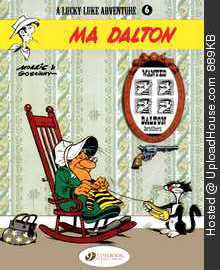
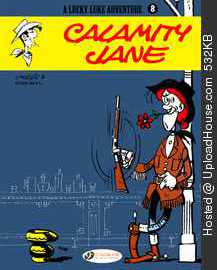
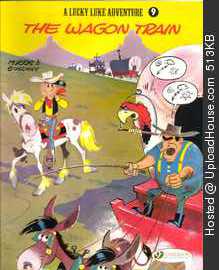
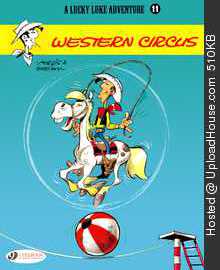
7 Lucky Luke Comics in English (Billy the Kid; Ma Dalton, Barbed Wire on the Prairie, Calamity Jane, The Wagon Train, Western Circus,The Rivals of Painful Gulch

Người đăng: Unknown on Thứ Tư, 6 tháng 4, 2011


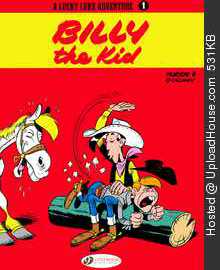
Lucky Luke 01 - Billy the Kid


Lucky Luke 06 - Ma Dalton


Lucky Luke 07 - Barbed Wire on the Prairie


Lucky Luke 08 - Calamity Jane


Lucky Luke 09 - The Wagon Train 


Lucky Luke 11 - Western Circus 


Lucky Luke 12 - The Rivals of Painful Gulch


Last month Maverick (a regular visitor) had informed about availability of these at  http://forum.mobilism.org/. One can read more details there. 
(who posted) with happiness, allowed sharing here. These are same "MEGAUPLOAD" links shared by him 
All thanks & credits go to both.

P.S. 5 more comics were already shared earlier: Check Here
More about

D2-146R - "Skorpi in Atlantis”(7/16/90 to 10/6/90)

Người đăng: Unknown

Flash Gordon D-2 Series Strip 
Art: Dan Barry 

Summary: Returning to Earth after his mind-opening experience on Mars (see D2-118 Mind Trip), Flash repeatedly baffles and frightens Dale and Zarkov in equal measure with his new powers.

Normal duty intervenes as Zarkov sends Flash away flight testing an enhanced version of a captured Skorpi ship, but Flash soon finds himself racing back in time anew to an unknown world, but still strangely familiar...
(Source of summary: www.ipcomics.net)  


It's from Emile's e-collection. All credits go to her & "Allen Lane" who scanned and first shared at net.

P.S.  It's partial reprint of D2-119.
More about

D2-145 - "In Search of Ming” (2/12/90 to 7/14/90)

Người đăng: Unknown

Flash Gordon D-2 Series Strip 
Art: Dan Barry 

Summary: Continuing his mission to avert disaster on Earth (see D2-144 Mission to Mongo), Flash is following the secret waterways under Mongo to Mingo City in the trusted company of an intelligence officer from Neptunia.

Realising too late that he is walking straight into a well-laid trap, Flash is forced to improvise to avoid the welcoming committee and enters a palace teeming with robotic guards and cybernoids...
(Source of summary: www.ipcomics.net)  


It's from Emile's e-collection. All credits go to her & "Allen Lane" who scanned and first shared at net.
More about

D2-144 - "Mission to Mongo” (12/15/89 to 2/10/90)

Người đăng: Unknown

Flash Gordon D-2 Series Strip 
Art: Dan Barry 

Summary: Setting course for Mongo on the unlikeliest of missions (see D2-143 The High Ground), Flash has to absorb some friendly fire and hairy moments in his Skorpi ship before he can bring his vessel down.

Trying to get his bearings before he can start his journey towards Ming’s palace, a disorientated Flash is about to reminded about the fact that an unannounced visitor on Mongo is never safe...
(Source of summary: www.ipcomics.net)  


It's from Emile's e-collection. All credits go to her & "Allen Lane" who scanned and first shared at net.
More about

Atom #7

Người đăng: Unknown on Thứ Ba, 5 tháng 4, 2011


In response to fan demand, DC liked to do team-ups with their heroes. Being DC, they tended to institutionalize the practice by making them annual events. Flash regular team-ups with Green Lantern, so it was a natural for Julius Schwartz to match his third GA reincarnation with his fourth.

The story, written by Gardner Fox and illustrated by Gil Kane and Murphy Anderson, starts with a bit of a puzzle. Some crooks had escaped from a tall building which was too far from nearby rooftops for them to have jumped. There was no sound of a helicopter, so how could they have escaped? They take the puzzle to local physics grad student, Ray Palmer who comes up with an answer:

In Gardner Fox's Wikipedia entry, there is this note:

A polymath, Fox sprinkled his strips with numerous real-world historical, scientific, and mythological references, once saying, "Knowledge is kind of a hobby with me." For instance, in the span of a year's worth of Atom stories, Fox tackled the 1956 Hungarian revolution, the space race, 18th-century England, miniature card painting, Norse mythology, and numismatics.


So it is no surprise that I was able to locate an article from Time Magazine in 1927 on the European fad of balloon jumping:
Walk along the ground with a breeze at your back, approach a fence, bend your knees, spring lightly into the air when you feel the tug of the balloon. You will sail over the fence so easily and land so gently that you will be surprised. Barns and trees can be surmounted with more vigorous leaps, usually requiring a light second push-up with the tip of the toe on the barn's roof or on the tree's outlying branches.

Balloon jumping is already a popular sport among the English gentry, and is attracting the attention of playful Long Islanders.

Later, while Jean and Ray are out bird-watching, they experience a strong earthquake. They also notice a bird that is out of the normal for the Atlantic Flyway.

Meanwhile, Hawkman has also noticed some birds out of their migratory routes. When he asks them why:

Using some special contact lenses he has designed, Hawkman is able to see the radiation is coming from the East Coast and:

We learn that explorers had found the Cosmitron on a world ruined by war. It gave off radiation, but aside from that the scientists from Thanagar could not determine the machine's purpose. Hawkman contacts Shayera, who is on Thanagar and tells her to check to see if the Cosmitron has been stolen. Then he heads east to find the source of the radiation.

The Atom is at the police station when a call comes in about the balloon robbers. He accompanies them to the scene:

Okay, now that's just a bit silly on Gil Kane's part; there's no way a couple of tiny balloons like those shown could lift even a fraction of a man's weight. Here's a look at what is actually required.

So the cop shoots Atom up into the air with the speargun, which is actually a pretty cool idea. He starts popping the balloons, but by the third crook they're over the getaway boat and so the man makes a quick getaway. Meanwhile, the Atom is so far out to sea that he wonders if he will be able to swim back to shore. Fortunately, he's plucked out of the air by... Hawkman!

The Winged Wonder and the Mighty Mite make short work of the balloon crooks, then Hawkman hurries off in search of the Cosmitron. He locates it lying on the ground in a woods, but as he approaches, tiny men in a space ship attack him:

The aliens manage to kayo Hawkman and get away with the device. Hawkman meets up with the Atom at police headquarters and tells his story. Meanwhile, the aliens are hovering above the Earth. We learn what the Cosmitron does:

They transmit a warning to the United Nations. They were the original rulers of our planet and they intend to resume control. If the UN does not capitulate, they will cause terrible disasters to strike our planet. Perhaps this is an optimistic view of the response of the delegates:

The aliens take a knife to the globe, causing a huge furrow to appear in the ground. We get a page or two of explication on the history of the aliens. They had used the Cosmitron to get control of many planets, but eventually the power (provided by earthquakes) ran out and the Thalens were overthrown. Many years later their descendants had recovered the Cosmitron and intended to resume their conquest of the galaxy.

Since Hawkman's spaceship is gone (with Shayera back on Thanagar), he cannot get to the alien ship, but the Atom can, in a model of Hawkman's craft. Once inside, he steals the Cosmitron:

And after a fairly easy battle, the aliens are defeated, the Cosmitron destroyed, and even the furrow repaired.

Comments: I loved the little bits of backup information that Fox provided, and the artwork is terrific. The Cosmitron is an interesting piece of technology. Atom and Hawkman had several other team-ups in the future and eventually shared the Atom's magazine towards the end of the Silver Age.
More about

D2-143 - "The High Ground” (8/23/89 to 12/14/89)

Người đăng: Unknown on Chủ Nhật, 3 tháng 4, 2011

Flash Gordon D-2 Series Strip 
Art: Dan Barry 

Summary: Preparing to ferry some unwanted visitors back to Mongo (see D2-142 Hari Hari), Flash is instructed by his sponsors at World Space Control to simultaneously transport a crate into space, but refuses to comply on security grounds as no-one is prepared to divulge its contents.
Refusing to go through with the mission, Flash suddenly finds himself smeared on a national television show. Suspecting powerful interests behind the move, Flash starts to unravel a complicated web of deceit to unmask the ruthless brain behind the uncompromising plot...
(Source of summary: www.ipcomics.net)  


It's from Emile's e-collection. All credits go to her & "Allen Lane" who scanned and first shared at net.
More about

Metal Men

Người đăng: Unknown on Thứ Bảy, 2 tháng 4, 2011

Commander Benson has a post up on the "New" Metal Men, the era in the late 1960s where the MM became more of a secret agent group than a collection of robots with amazing powers. As CB notes, DC made an oddball decision to change what had been a pretty successful series, and to eliminate the basic premise for the series.

This development, and the notion of giving the Metal Men human appearances, destroyed the most inviting aspect of the series. One of its strengths had always been that, in action, the Metal Men provided remarkable visuals for the reader---Gold stretching into lengths of micrometre-thin wire; Mercury turning into globs of fluid; Iron and Lead changing into massive walls or constructions. Even at repose, they had been striking in terms of colour---gold, red, blue, grey, silver, white.


Indeed. Although I covered the initial Metal Men Showcase tryout issue earlier, I thought it might be interesting to take a longer look at the team.

As mentioned in CB's post, one of the interesting facets of the Metal Men was the way the stories contained a relatively painless introduction to chemistry. It was a rare issue that didn't contain something like this:

Or this:

Or this:

And editor Robert Kanigher often used educational fillers:

Another interesting thing about the series was that the robots were all given different personalities. This was blamed on Doc Magnus' (the creator) "faulty responsometers". Mercury was a hot-tempered martinet, while Gold was noble and intelligent. Lead and Iron were lunkhead strongmen. Tin was perhaps the most interesting character, with his oddball combination of timidity and courage, as I discussed years ago. The final member of the initial team was Tina, a platinum beauty who was madly in love with her inventor:

Mmmmm, machine oil!

I classify the series as "superhero" in nature, mainly because the robots do things that shouldn't ordinarily be possible. For example, while we accept that platinum could be stretched out into an extremely fine wire, is it reasonable that a platinum robot could do so? There are presumably gears and pulleys inside that would be damaged, right? In addition, Iron and Lead are often shown making themselves much bigger than normal; how exactly do they add that mass to their forms?

As mentioned above the series was pretty successful. Here are the circulation figures for 1964:

1965:

And 1966:

Metal Men was moving 396,000 copies an issue! But in the next two years, sales just plain collapsed, probably due to Batmania and the superhero craze that accompanied it. Sales were down to 240,000 per issue in 1967 and 207,000 in 1968, putting the series dangerously close to the 200,000 mark where DC in that era typically cancelled titles.

I agree with CB that the change was a mistake. The problem with dramatic shakeups is that they are almost certain to annoy a large percentage of your existing audience, with no guarantee that it will capture new readers.
More about