Amazing Spiderman #46-47

Người đăng: Unknown on Thứ Bảy, 16 tháng 9, 2006

ASM #46 starts rather abruptly. Spidey, his arm still in a sling from his battle with the Lizard in #44, encounters the Shocker, a guy with special vibrating gloves which give him extraordinary power. He kayos Peter and gets away.

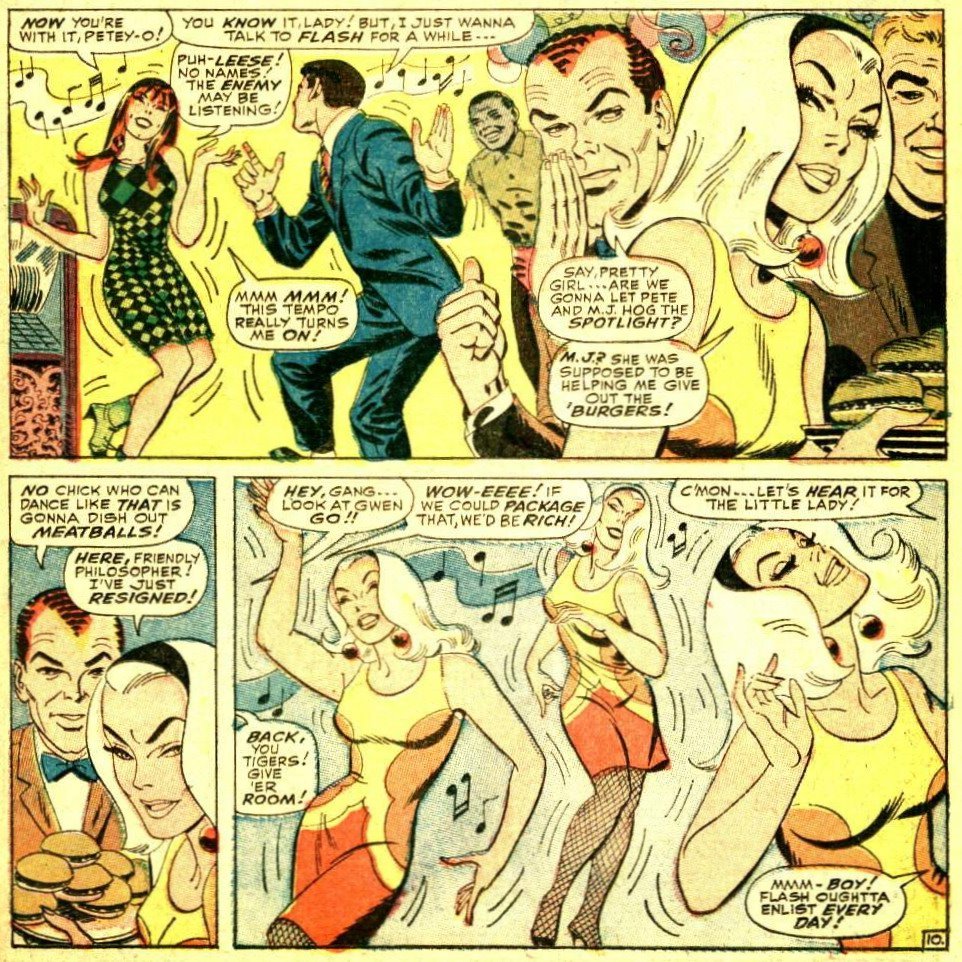
The next big event in Peter's life comes later. Harry Osborn's dad has rented an apartment for him close to Empire State U. He invites Peter to take the second bedroom. Of course, our hero is thrilled at the prospect, but has to figure out whether it would be an inconvenience to Aunt May. Fortunately, she has already decided to move in with Anna Watson, so for once things seem to be breaking Peter's way. At this point he appears to be casually dating Mary Jane, but Gwen is starting to interest him more.

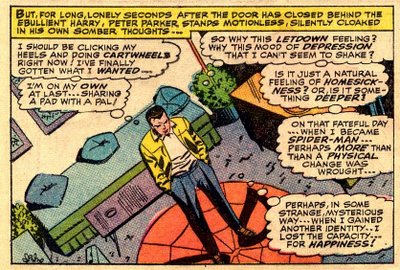
Spidey handles the Shocker in their second battle by not allowing the crook to use his thumbs on the vibrating gloves. Some modest pop culture and political references; Spidey mentions Hubert Humphrey and The Man from UNCLE. Still, we get some inevitable teenage angst here:


Kraven returns in #47, as well as (briefly, in flashback) the Green Goblin. We learn that Gobby had hired Kraven to attack Spiderman in ASM #34, something that was not disclosed at that time. In addition, Norman Osborn himself (aka the Green Goblin) had acted as a go-between, exposing himself as a crook to Kraven.

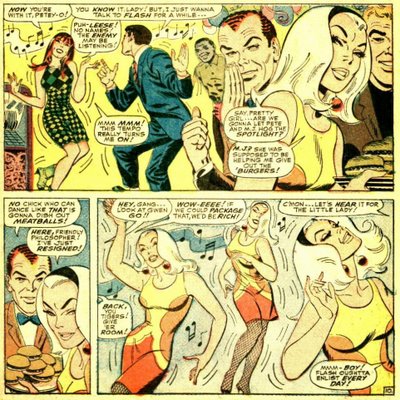
Kraven has developed a new ray that will eliminate Spidey's super-speed, and is confident once that is gone he will be able to subdue Webhead. We get a long dose of the Archie stuff:


But eventually the battle starts. Kraven decides to kidnap Harry, who's with Peter at a going-away party for Flash Thompson, who's been drafted into the army as discussed in earlier issues. Peter sneaks away and reappears as Spiderman. He taunts Kraven into dropping Harry and they fight. This time Kraven defeats him with his ray, but stops short of killing him when Norman Osborn shows up. However Kraven is baffled when his jungle senses tell him that Osborn doesn't remember him at all. Of course, he had no way of knowing that Osborn has amnesia about his Green Goblin years. Kraven decides that his victory over Spiderman is enough and dashes off.
More about

Lo, There Shall Come a Geek

Người đăng: Unknown on Thứ Hai, 4 tháng 9, 2006

Of all the weird heroes to arise at the end of the Silver Age, and there were a lot of them, perhaps none was weirder than Brother Power, the Geek. A creation of Joe Simon, the less famous half of the Simon & Kirby team, Brother Power came to life via spontaneous generation. He was originally a tailor's dummy, but combined with the heat from a radiator, a little machine oil, and a spark from a bolt of lightning, he came to life.

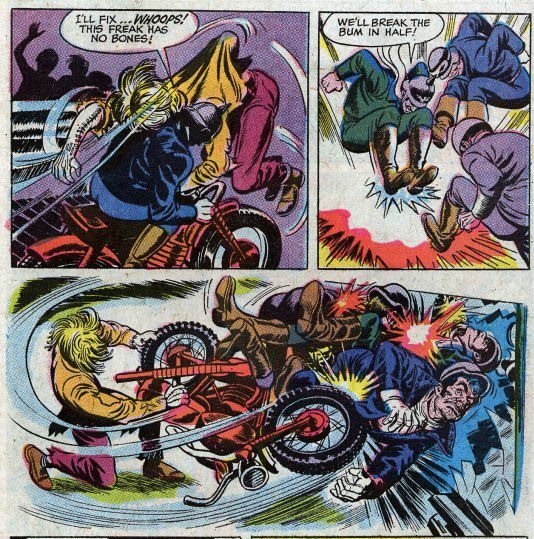
He was initially a friend of hippies, but aspired to more than their lifestyle. He had incredible strength, which came in handy for beating up a bunch of motorcycle goons:


In the first issue he's kidnapped to be a featured attraction at a carnival freak show, but his hippie buddies rescue him. He decides he wants to become a politician, but the carnival operators convince the cops to arrest him for breaking up their tents. At the end of the first issue he drives off the Golden Gate Bridge.

In the second issue, after being pulled from the deep by another group of losers, and almost kidnapped by a bizarre Baron with a Fokker biplane (sic), Brother Power goes into the world of business. He rapidly moves up the ladder, with smart thinking and hard work. Eventually he runs a major missile plant, beating out a villain named Lord Sliderule. But Sliderule gets revenge by sabotaging a missile launch. BP is once again wanted by the police. He sneaks into the missile in an attempt to escape but Lord Sliderule blasts it into space. The hippies manage to convince the cops that LS is to blame for the problem with the missile launch, but in the meantime, what will happen to Brother Power?


Despite the promise of a next issue, none appeared and Brother Power, The Geek was sidelined for several decades, although he did pop up in a couple comics in the 1990s.

In retrospect, it seems like DC had decided to try to go after the burgeoning hippie market. In some ways this seems inspired, but of course as with much that DC did back then, it was half-hearted. It poked fun at the hippies for their laid-back lifestyle and while this was certainly a fair criticism, it did undercut the marketing to many teens who saw the hippies as role models (mostly because they were their older brothers).

This Wikipedia entry certainly indicates that BPtG was controversial in DC's halls.

While sales of the title were modest, Brother Power was not popular among the staff. DC Comics artist Carmine Infantino claimed in an interview that Superman editor Mort Weisinger disliked the character very strongly, and petitioned DC publisher Jack Liebowitz to shut down the title. Weisinger hated hippies and felt that Simon portrayed them too sympathetically.
More about

The Spiderman TV Cartoon

Người đăng: Unknown on Chủ Nhật, 27 tháng 8, 2006


I don't remember the original 1960s run of these cartoons, but recall them more from the early 1970s in the afternoon. As you can see, the quality is pretty mediocre, and it would get worse before the end of the run (this was the tenth episode). Most adaptations of comics were pretty cheesy back then; it wasn't until the Superman movie in about 1978 that anybody approached the subject of superheroes with real respect.

Obviously the biggest impact of the Spiderman cartoon series was the theme song, (snipped from this cartoon) which has been incredibly durable. Here it is:


I always liked the part about "In the chill of night at the scene of a crime...."
More about

DC, The Home of WeirDCrooks

Người đăng: Unknown on Thứ Bảy, 19 tháng 8, 2006

In the Golden Age, it was seldom necessary to give criminals a motivation. They were just crooks, simple as that. Some of them (Luthor notably) also were mad scientists, a bogeyman familiar to youngsters from the TV and radio serials.

But as the Silver Age wore on, establishing a motive for the criminal behavior became more important. Two of the oddest motivations came from Captain Cold and Sonar.

Captain Cold was one of the Silver Age Flash's first villains, appearing in Showcase #8, the second comic to feature the Scarlet Speedster. His weapon was a gun that could freeze things instantly; a rather pedestrian power. But he was an interesting character nonetheless because his reason for pursuing a life of crime was to impress women.

Initially he had a crush on Iris West, Barry Allen's girlfriend, but would later transfer his affections to other women. Along the way, he picked up a supervillain polar opposite named Heat Wave, who frequently was his rival for the affections of women.

Sonar, on the other hand, had the ability to control sounds with a special tuning fork. Again, this is not an ability likely to fascinate readers for long. But Sonar's back story was wild. He came from a small European country named Modora. Frustrated that his homeland was not a player on the world stage, he resolved to make it a major power.


In one of the annoying coincidences that plagued Green Lantern in the early years (see for example, my earlier post about Qward), GL discovers Sonar because he is searching for a stamp from Modora. He searches the mind of an old clockmaker, whose apprentice, Bito Wladon (Sonar) has just quit the job. The clockmaker is worried because Wladon had discussed his dangerous ideas before leaving.

GL battles Sonar twice, but each time the villain manages to escape. The third time turns out to be a charm and in gratitude, the citizens of Modora issue a special stamp for Green Lantern to give to Pie-Face.
More about

Fantastic Four Annual #1

Người đăng: Unknown on Thứ Bảy, 12 tháng 8, 2006


As I have discussed earlier, DC's success with "Annuals" (really 80-page reprint mags) resulted in Marvel looking to add this profitable niche to its line. The problem was that Marvel had not been publishing their superheros long enough to be able to reprint stories and expect them to sell very well, or so they thought. So Fantastic Four Annual #1 featured a brand new double-length story with the FF facing the Sub-Mariner and his Atlantean hordes.

This was the first time since Namor's return in FF #4 that he appears in Atlantis. We learn that the Atlanteans are blue in color, which raises some questions about the claims that he is "a prince of the blood" as one character puts it. We also learn that he has a love, Lady Dorma, and a rival for both the throne and the girl, in the Warlord Krang. He gives a speech to his subjects in which he vows to make the "insolent human race pay for its crimes against our people."

The next sequence shows us the FF in a typical opening, with Johnny and Ben fighting. This time they damage some of Sue's priceless gowns. In an effort to relieve the team's tension while accomplishing some business, Reed suggests a cruise of the Atlantic, where sea monsters have been reported recently.

The sea monsters turn out to be a trap for the FF. Namor advises Reed that he declares the seas and the skies above them as his territory, banning any overseas boating or flights. This of course will mean war with the humans.

There follows a brief bio of Subby; turns out he's the product of a marriage between an human and an Atlantean princess; hence the caucasian skin. The Sub-Mariner's forces quickly take over New York and other major cities on the coast. However, the invasion is thwarted when Reed manages to create an evaporation ray, depriving the Atlanteans of the water in their helmets that they need to survive on land.

Angered, Namor kidnaps Sue Storm. While the boys fight it out above, Dorma, in a fit of jealousy, breaks a window in the undersea room where Sue is being held. Sue, realizing it is her only hope, jumps out the broken window. But she becomes tangled in some seaweed, and nearly drowns. Namor flies her back to the mainland to a hospital. But his act of selflessness has a price, as the Atlanteans feel betrayed and desert him.

In the second feature, the brief encounter between Spiderman and the FF from ASM #1 is retold in an extended version. The book also contains a reprint of the FF's origin from Fantastic Four #1, and a gallery of their most memorable villains.
More about

Ultra, the Multi-Alien

Người đăng: Unknown on Chủ Nhật, 6 tháng 8, 2006

DC introduced a lot of weird characters in the late 1960s, but few of them were weirder than Ultra, The Multi-Alien. Ultra was Ace Arn, a space explorer from the near future, who was accidentally transformed into a freak with the composite powers and body of four different aliens. As was becoming common, some of the conflict in the story was actually internal; the hero was unhappy with being "different". See Ben Grimm (Thing), Metamorpho, the Doom Patrol and others. At first one of the agonies for him was the loss of his girlfriend, Bonnie Blake, but eventually she accepted him despite his strange appearance.

Ultra's powers were pretty basic--he could fly, had incredible strength in one arm, could shoot lightning and had magnetic powers as well. He first appeared in Mystery in Space #103, taking over the cover and feature slot from Adam Strange. There were eight appearances in all, with #110 spelling the end for both the Multi-Alien and Mystery in Space.

More about

Lois Lane

Người đăng: Unknown on Chủ Nhật, 30 tháng 7, 2006

Lois Lane famously appeared alongside Clark Kent in Action Comics #1. In the early Superman stories, Lois appears to despise Clark, who loves her and longs to win her himself, although it quickly becomes apparent that she's more interested in Superman.

Lois earned a feature of her own right in Superman #28. Although the title of the feature may seem sexist to us now, "Lois Lane, Girl Reporter" was accurate at the time. Many newspapers had a "girl reporter" as something of a novelty--Nellie Bly being the most famous. The stories were generally four pages long and emphasized comedy over drama, much like the Alfred series that was printed in Batman around the same time.

In 1954, a Superman supporting character was given a solo book, but it wasn't Lois Lane or even editor Perry White. Rather it was Jimmy Olsen. Olsen had been a relatively minor character in the comic books up till that time. In fact, he was so minor that in Superman #72, a character looking exactly like the Silver Age Olsen appeared, as Perry White's son!

Of course, Olsen had been a much more significant character in both the Superman radio show and on television, which is the most probable reason for the sudden launch of Superman's Pal, Jimmy Olsen.

Lois didn't get her shot until Showcase #9, July-August 1957. She had one more tryout in the following issue, and in March-April 1958 Lois Lane #1 appeared on the newsstands. That issue also included the first artwork by the man who was to define Lois for the rest of the Silver Age, Kurt Schaffenberger.

Schaffenberger had drawn Captain Marvel back in the Golden Age, and he seemed to sense that Lois Lane needed to be slightly different from the ultra-serious Superman series. The covers often featured Lois or Superman in a particularly humiliating, yet comical situation, such as this:


The stories from this era are always a guilty pleasure. They have just the right amount of whimsical humor without quite dissolving into farce. A frequent theme had Lois being wooed by another man, either wealthy or powerful. Of course, Lois' goal was always to marry Superman, and there was a continuing "imaginary" series including the above story about the trials and tribulations of being married to the Man of Steel.
More about